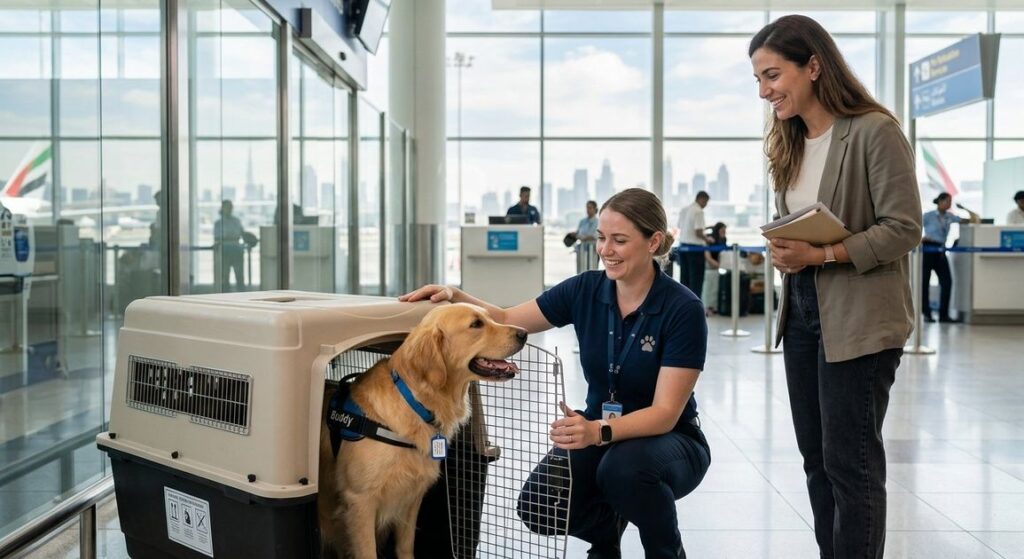
Dubai is home to thousands of expats who move there with their pets throughout the year. The process of pet relocation in Dubai can seem a bit complicated, as different countries, different laws, and tight deadlines all affect the animal relocation process. Furthermore, failure to complete the required paperwork may result in your pet being refused entry or placed in quarantine upon arrival.
Therefore, this guide will provide you with all the necessary procedures for pet relocation in Dubai without encountering any obstacles during the transfer. So, whether you are planning to move your pet from Dubai or doing pet export from Dubai in the near future, this guide will help you comply with the laws regarding pet travel requirements in the UAE.
Step-by-Step Pet Relocation Process
Some countries have strict laws regarding pet relocation in Dubai, so missing any step can delay travel by weeks or months.
| Timeframe | Steps |
|---|---|
| 6+ months before | Research destination country requirements → Start vaccinations if not current |
| 4–6 months before | Rabies vaccination (if not current) → Microchip verification (ISO standard) |
| 3–4 months before | Rabies titer test (blood draw) → Wait for results (2–3 weeks) → Some countries require waiting period AFTER titre |
| 1 month before | Book airline → Purchase IATA-approved crate → Crate training |
| 10 days before | Final veterinary health examination → Health certificate issued |
| 1–5 days before | Government endorsement of health certificate (MOCCAE) → Final paperwork check |
| Travel day | Arrive early, have all originals + copies |
Universal Requirements (All Destinations)
Before traveling with your pet to any country, there are a number of basic requirements that must be followed to ensure a safe and problem-free journey. These procedures are standardized in most countries and aim to protect the animal and prevent the spread of diseases.
ISO Microchip (15-digit)
A 15-digit ISO-compliant microchip must be implanted before rabies vaccination. If the chip is non-compliant, it must be replaced with an approved one.
Current Rabies Vaccination
Rabies titer tests in Dubai must be valid and administered at least 21 days before travel. Some countries require a specific expiration date for the Rabies vaccination.
You can book a vaccination appointment today.
Veterinary Health Certificate
A pet health certificate in Dubai must be issued within 10 days prior to travel and confirms that the animal is healthy. It often requires approval from a relevant government agency; Paw Sisters can issue this health certificate.
IATA-Approved Travel Crate
The crate must be appropriately sized, well-ventilated, securely closed, and include a water container and a “Live Animal” label.
Country-Specific Requirements
When it comes to pet relocation in Dubai, travel requirements vary. Here are the most important requirements for pet travel in the world’s most popular countries to help you avoid travel bans or waiting upon arrival:
United Kingdom
The United Kingdom is considered one of the countries with the easiest and most organized procedures for transporting pets, ensuring smooth entry without quarantine. These requirements include:
- The first step is microchipping, followed by rabies vaccination and a 21-day waiting period before travel.
- Antibody testing is not required in most cases, which facilitates travel.
- A health certificate in AHC format must be obtained within 10 days before travel.
- Travel is required via airlines and routes approved for transporting animals to the UK.
- Treatment for tapeworms must be administered 1 to 5 days before travel and is mandatory for dogs.
- If all requirements are met, pets will not be quarantined.
United States
Regarding the entry of pets into the United States, it’s worth noting that the laws regarding pet imports have been updated since 2024. The most prominent entry requirements include:
- A CDC Dog Import Form must be completed before dogs can enter the United States.
- Microchipping is required, along with a valid rabies vaccination, but details may vary by state (some are stricter).
- Some states may require additional vaccinations besides rabies, so it’s advisable to check the specific requirements of your state.
- A USDA veterinary health certificate is required, and Paw Sisters clinics can assist in obtaining it.
- The entry requirements for cats are less stringent than for dogs and often don’t require the same level of procedures, but a health certificate is always recommended.
European Union
Unlike other countries, the European Union imposes a strict system for the entry of pets, requiring advance planning:
- Microchipping, rabies vaccination, and a health certificate.
- Rabies Titer Test: A blood sample is taken at least 30 days after vaccination, and results take approximately 2–3 weeks.
- After a positive result, a 3-month waiting period is required before travel.
- A certificate in EU format must be issued.
Australia
Australia has strict regulations regarding the importation of pets. Key requirements include:
- Mandatory quarantine: 10 days upon arrival.
- Import Permit: An import permit must be obtained from the Australian government before travel.
- Medical Examinations: These include a Rabies Titer test and comprehensive blood tests.
- Parasite Treatment: A strict program for treating internal and external parasites is required according to a specific schedule.
- Advance planning: Procedures should begin at least 6 months before travel.
India
If you plan to travel to India with your pet in the coming period, here are the essential requirements:
- No Objection Certificate (NOC): Obtained from the Animal Quarantine Authority.
- Rabies vaccination: A valid vaccination certificate is required.
- Health certificate: Issued within just 3 days before travel (a very short timeframe).
- Import permit: Obtained from the destination city within India.
Other Common Destinations
Canada:
Relatively simpler procedures; microchip + rabies vaccination + health certificate. Quarantine is often not required if the paperwork is complete.
South Africa:
Requires prior import authorization, along with veterinary inspections and a valid health certificate.
Saudi Arabia (domestic/regional movement):
Requires a health certificate and valid vaccinations, in compliance with local import regulations.
Egypt:
Requires a health certificate and valid rabies vaccination. Procedures are generally simpler compared to other countries.
For destinations not listed, contact Paw Sisters for country-specific guidance.
Rabies Titer Test — Everything You Need to Know
The Rabies Titer test involves measuring the level of antibodies to a specific disease in a blood sample. Antibodies are produced in response to an antigen or trigger. A dog’s body can produce antibodies after vaccination or after infection with bacteria or viruses.
Vaccines provide a modified or harmless version of the original disease. These tiny cells stimulate the immune system to produce specific antibodies, or disease-fighting cells.
Afterward, the dog’s immune system has a pool of cells ready to fight off the disease quickly if it becomes infected. As a result, the dog will either not get sick or its symptoms will be significantly reduced.
It is worth noting that this test is required by the EU, Australia, Japan, and many other countries. Results take 2-3 weeks from the approved laboratory, and some countries require a 3-month waiting period AFTER satisfactory results.
Airline Regulations & Breed Restrictions
Cabin vs. Cargo vs. Checked Baggage
- Cabin: Typically allows pets weighing less than 8 kg, including a carrier (available in limited quantities).
- Cargo: For larger pets – a pressurized, air-conditioned cargo hold.
- Some airlines (such as Emirates): Only allow pets in the cargo hold and do not permit them in the cabin.
Brachycephalic (Snub-Nosed) Breed Restrictions
Many airlines impose restrictions or prohibit entry for snub-nosed dog breeds such as bulldogs, pugs, Persian cats, and Boston terriers.
Emirates only allows them during the colder winter months (November to April).
The primary risk associated with banning these breeds is difficulty breathing in the cargo hold. Therefore, if you have a snub-nosed dog, plan your travel dates carefully.
Popular Airlines from Dubai
Airline
Pets in Cabin
Pets in Cargo
Restrictions
Emirates
❌
✅ (via Emirates SkyCargo)
BOAS breeds Nov-Apr only
Etihad
✅ (small pets)
✅
Weight limits apply
FlyDubai
❌
✅
Limited routes
Qatar Airways
✅ (select routes)
✅
Breed restrictions
Costs Breakdown
Please note that these prices are approximate and subject to change.For a personalized cost estimate, book a relocation consultation at Paw Sisters.
Item
Approximate Range
Rabies titer test
AED 800–1,500
Health certificate + exam
AED 300–600
MOCCAE endorsement
AED 200–400
IATA crate (medium dog)
AED 500–2,000
Airline cargo fee
AED 2,000–8,000+
Professional relocation agent (optional)
AED 3,000–10,000+
Common Mistakes That Delay Relocations
-
Microchipping after rabies vaccination: This should be done before vaccination, otherwise the process will have to start again.
-
Not allowing enough time for antibody test results and waiting periods.
-
Choosing an unsuitable crate size, which will result in rejection by the airline.
-
Expired health certificate (usually valid for only 10 days).
-
Failure to check breed restrictions before booking flights.
-
Forgetting to update the microchip database with current contact information.
-
Failure to acclimate the pet to the travel crate beforehand.
FAQs
How far in advance should I start planning?
Minimum 3 months, 6+ months for Australia/Japan/EU.
Can Paw Sisters handle the entire relocation process?
We handle all veterinary requirements; we can recommend relocation agents for logistics.
Is pet travel safe?
Yes, millions of pets fly safely each year with proper preparation.
What if my pet has a health condition?
Discuss with your vet; some conditions require special clearance
Conclusion
Relocating with your pet doesn’t have to be stressful. With the right timeline and veterinary support, the process is straightforward. At Paw Sisters, we support you with a personalized consultation that includes all the necessary requirements for moving to your specified destination, to ensure that you do not experience travel delays or expose your pet to quarantine.
Planning a move? Book a Relocation Consultation at Paw Sisters — we’ll create your personalized timeline